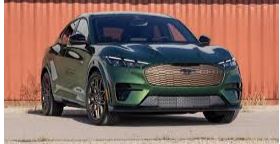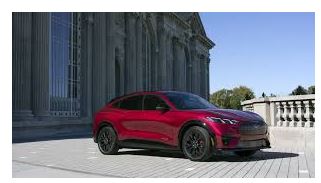
Ford Mustang Mach-E — present, price, and what’s next
The Ford Mustang Mach-E arrived in 2020 as Ford’s bold statement that the Mustang nameplate could carry an electric future. It’s a five-seat crossover that blends Mustang styling cues (fastback profile, tri-bar taillamps, pony badge) with mainstream EV practicality: usable cargo space, a frunk, high-tech infotainment, and multiple powertrain choices. Over the model years Ford has refined hardware and software, added sportier GT and off-road-leaning Rally variants, and incrementally improved range and features. For a buyer it offers a familiar brand, distinctive looks, and a driving character that aims to sit between mainstream crossovers and sporty EVs.
https://www.ford.com/
+1
What you get (trim, battery, range, performance)
The Mach-E is offered in several trims — Select, Premium, GT, and Rally (and special packages like the Sport Appearance or GT Performance upgrades) — and with either rear-wheel drive (single motor) or eAWD (dual motor). Battery options typically include a standard-range pack and an extended-range pack; quoted capacities in recent spec sheets sit around the low-to-mid-80 kWh (usable) range for extended packs and roughly 70–75 kWh for standard packs, depending on the model year and the testing/marketing figures used. That translates to real-world EPA or manufacturer estimates from roughly ~230 miles on lower-range configurations up to ~320+ miles on RWD extended-range versions under ideal conditions. The GT and Rally models deliver significantly quicker acceleration and higher torque figures, while the Select and Premium focus more on value and daily usability.
Car and Driver
+1
Interior and technology
Inside, the Mach-E emphasizes a minimalist, modern cabin highlighted by a vertically oriented 15.5-inch portrait touchscreen running Ford’s SYNC 4A software, a slim digital instrument panel, and plenty of connected features (over-the-air updates, navigation with EV trip planning, streaming and in-car Wi-Fi in some packages). For 2025 Ford standardized a heat pump to improve cold-weather efficiency and moved the shifter to the steering column to free console space; ventilated seats and optional appearance packages give buyers a range of comfort and style choices. Driver-assist tech includes Ford’s BlueCruise hands-free system on certain highways (with driver monitoring), though that package has attracted regulatory attention — more on that later.
https://www.ford.com/
Pricing — what it costs now (and why it’s moved)
Pricing for the Mach-E has been a moving target. When Ford entered the market it priced the Mach-E to compete with mainstream EV SUVs rather than ultra-premium rivals. Over the model years, base MSRP figures have ranged in the high-$30k to mid-$40k area for entry trims, with performance GT models typically appearing in the mid-$50k range before options. For example, MSRP windows reported in recent reviews and dealer listings for 2025 models show base pricing in the mid-$30,000s to low-$40,000s with GT trims above $50,000. Dealers and national listings can show variation based on incentives, dealer markup, and available rebates.
https://www.ford.com/
Why has price moved? A few reasons:
- Market competition and pricing pressure — Tesla’s Model Y and numerous new compact EV crossovers forced OEMs to reprice or add incentives to stay competitive. In early 2024 Ford cut Mach-E prices across the lineup by thousands to re-align with market realities.
- Reuters
- Incentives and tax-credit eligibility — federal EV tax-credit rules (and their supply-chain requirements) have affected the effective price many buyers pay. At times the Mach-E has been ineligible for the full federal credit, altering buyer calculus and Ford’s pricing strategy.
- Reuters
- Trim and feature creep — adding new technology (e.g., heat pumps, BlueCruise improvements, premium audio) can push average transaction prices upward even if base MSRPs are trimmed.
As always, the exact on-the-lot price will depend on current Ford national offers, local dealer pricing, and any applicable state or local incentives; Ford’s pricing pages and dealer inventories are the best places to check live numbers.
https://www.ford.com/
Ownership costs and charging
EV ownership changes the cost picture: lower routine maintenance (no oil changes, fewer moving parts) and lower “fuel” costs if you charge at home. Ford promotes its BlueOval charge network integrations and offers programs to make home charging easier; charging speed depends on battery chemistry and charger power — typical home AC charging fills overnight while DC fast charging can add highway-range minutes in a short stop, though the fastest charging depends on station and battery temperature. Ford publishes estimates for home-charge times and Ford dealers frequently include offers for home chargers as part of purchase incentives.
https://www.ford.com/
Safety, reliability, and quality issues to be aware of
The Mach-E’s history includes a few notable safety and regulatory items buyers should know:
- Door-latch recall (2021–2025 models): Ford announced a recall for a significant number of Mach-Es (model years 2021–2025) related to electronic door-latch software that could cause doors to remain locked, potentially trapping occupants. Ford planned to address affected vehicles with a software update. This is an important practical matter for current owners and prospective buyers assessing used models.
- AP News
- BlueCruise regulatory scrutiny: The U.S. NHTSA upgraded a probe into roughly 129,000 Ford vehicles with BlueCruise hands-free tech (which is available on Mach-E models), moving to an engineering analysis phase following serious collisions. This could result in further actions or changes to the feature depending on outcomes of investigations. Buyers should treat hands-free tech as an advanced driver-assist system — helpful, but not a replacement for active driver attention.
- Reuters
On the upside, reviewers praise the Mach-E’s structural design and occupant space; federal and independent crash-test results and any open recalls are public and should be checked before purchase.
Car and Driver
+1
Sales, production and market performance
After an initial strong reception, Mach-E sales trended variably as the EV market expanded and competitors multiplied. Ford has adjusted production levels at the Cuautitlán plant (where many Mach-Es are assembled) in response to demand and supply fluctuations; production data reported in 2024 showed some declines in monthly output as Ford balanced inventory and demand. Macroeconomic factors, supply-chain disruptions, and shifting consumer preferences for different EV segments have all influenced volume.
Ford Authority
+1
Ford’s overall EV strategy includes the Mustang Mach-E alongside the F-150 Lightning and E-Transit commercial van. How Ford balances investment across those programs — and whether it re-positions models or adjusts options to chase market niches — will shape Mach-E availability and support.
Ford Corporate
Competition — where Mach-E fits
The compact/performance EV crossover segment is crowded. The Mach-E competes with the Tesla Model Y, Volkswagen ID.4, Hyundai Ioniq 5, Kia EV6, and other newcomers — plus luxury offerings from BMW, Mercedes-Benz, and Volvo. The Mach-E’s strengths are Mustang DNA (branding and styling), a range of trims including performance-oriented GTs, and Ford’s dealer network for service and support. Its challenges are intense price competition, rapid advances by rivals in range/charging, and the occasional negative headlines from recalls or tech probes. Buyers prioritizing driving dynamics and Mustang styling may prefer the Mach-E; those prioritizing the broadest charging network or longest range might compare closely with Tesla and other players.
Reuters
Software and upgrades — living car, evolving product
One advantage of modern EVs is that many improvements come via software updates. Ford has used over-the-air updates to refine range management, infotainment features, and driver-assist functionality. That raises the ownership value proposition — hardware can stay relevant longer if software continues to improve. However, it also ties long-term value to Ford’s commitment to updates and the speed with which it addresses bugs or safety items. The recall that is being fixed via software updates shows both the flexibility of OTA fixes and the risks when critical systems need patches.
AP News
+1
The Mach-E’s future — three plausible scenarios
Predicting the precise path for a single model is uncertain, but informed scenarios help understand likely directions:
- Sustained mainstream player with iterative updates — Ford continues investing modestly in the Mach-E, refreshing features and trims year-to-year (as it did for 2025 with heat pumps and appearance packages), keeping MSRP competitive, and positioning the Mach-E as a mature, widely available EV in Ford’s lineup. This is plausible if demand stabilizes and Ford balances production to match market segments.
- https://www.ford.com/
- Niche & performance halo model — Ford could choose to prioritize Mach-E as a performance halo (GT, Rally) and emphasize higher-margin versions while funneling volume EV growth into other platforms (like dedicated ride-oriented platforms). That would keep the Mach-E visible and desirable but less central to mass-market EV volume. Evidence of special-edition and sport packages supports the idea that Ford values the Mach-E’s image capital.
- Phased evolution into new architectures — as Ford rolls out new EV platforms and cell supply matures, Mach-E could be redesigned or succeeded by a next-gen Mustang EV built on a dedicated platform with higher density batteries, faster charging, and scaled production economics. Large automakers often replace initial EV models with next-generation platforms when the supply chain and market allow it. Ford’s overall EV plans will influence whether Mach-E stays largely as it is or evolves onto a fresh architecture.
- Ford Corporate
Should you buy one today?
Consider your priorities:
- Buy a Mach-E if you want distinctive styling, a range of trims (from efficient to high-performance), dealer service access, and the convenience of living with an EV that gets periodic feature updates. For many buyers the Mach-E represents a strong value proposition in the sporty EV crossover market.
- https://www.ford.com/
- +1
- Be cautious if you rely heavily on the hands-free features as a safety crutch: BlueCruise and automated lane-change tech are powerful but under regulatory scrutiny; treat them as assisted driving, not autonomy. Also check recall status and whether any needed software updates have been completed on used examples.
- Reuters
- +1
- Shop pricing actively — compare dealer offers, check for state incentives, and consider total cost of ownership (home electricity rates, charging behavior) rather than MSRP alone.
- https://www.ford.com/
Final take — the Mach-E in perspective
The Mustang Mach-E has done something rare: it transplanted a legacy performance badge onto an EV platform and made the resulting product desirable to a wide spectrum of buyers. It’s not perfect — price churn, production adjustments, and safety/regulatory items have complicated its path — but it remains a meaningful part of Ford’s EV story: a visible, characterful, and competitive electric crossover that gives buyers a distinct alternative to the sea of more anonymous EVs. How Ford stewards the Mach-E — whether as a continuing mainstream offering, a performance halo, or a stepping stone to a next-generation Mustang EV — will shape its long-term role. For now, it’s a mature, feature-rich EV with a clear personality and real strengths for the right buyer.
https://www.ford.com/
+2
Reuters
+2