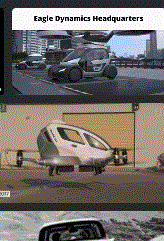
Latest Flying Cars in 2026: The Future of Personal Air Mobility
The idea of flying cars has fascinated humanity for more than a century. From science fiction movies to futuristic concept art, the dream of owning a vehicle that can both drive on roads and fly through the sky has always symbolized technological progress. In 2026, that dream is closer to reality than ever before. Thanks to breakthroughs in electric propulsion, lightweight materials, battery technology, and autonomous systems, several companies around the world are developing real flying cars designed for commercial use.
Today’s flying cars are often referred to as electric vertical takeoff and landing (eVTOL) vehicles. Unlike traditional airplanes, they do not require long runways. Instead, they use electric motors and multiple rotors to take off vertically like a helicopter. Many of these vehicles are designed for short urban trips, air taxi services, and even private ownership in the near future.
This article explores the latest flying cars in 2026, their technology, leading companies, advantages, challenges, and what the future holds for personal air mobility.
What Is a Flying Car?
A flying car is a hybrid vehicle that can operate both on roads and in the air, or in some cases, function as a small electric aircraft designed for urban mobility. Modern flying cars generally fall into two categories:
- Roadable aircraft – Vehicles that can drive on roads and transform into airplanes.
- eVTOL air taxis – Electric aircraft designed primarily for air travel within cities.
Most of the latest models focus on electric propulsion, autonomous systems, and environmentally friendly operation.
Major Companies Developing Flying Cars
1. Alef Aeronautics
Alef Aeronautics is one of the most talked-about companies in the flying car industry. The company has introduced a prototype that looks like a futuristic car but can lift off vertically and fly over traffic.
Key Features:
- Fully electric propulsion system
- Vertical takeoff and landing
- Road-legal driving capability
- Estimated flight range: around 110 miles
- Driving range: around 200 miles
Alef’s flying car is designed for urban commuters who want to avoid traffic congestion. The company has already received pre-orders and is working toward regulatory approval in the United States.
2. PAL-V
PAL-V, based in the Netherlands, is developing a roadable aircraft that looks like a combination of a car and a gyrocopter. Their model, the Liberty, is one of the first flying cars to receive road certification in Europe.
Key Features:
- Two-seat design
- Uses gasoline engine (not fully electric)
- Requires a short runway for takeoff
- Can convert from car to aircraft in minutes
Unlike many eVTOL designs, PAL-V’s vehicle flies like a traditional aircraft and requires a pilot’s license.
3. Terrafugia
Terrafugia, backed by Chinese automotive giant Geely, has been developing flying car prototypes for years. Its Transition model is a roadable light sport aircraft.
Key Features:
- Foldable wings
- Hybrid-electric power system
- Designed for personal travel
- Requires runway for takeoff
Terrafugia focuses on blending traditional aviation safety standards with automotive usability.
4. Joby Aviation
Joby Aviation is one of the leading eVTOL developers in the United States. Although not a traditional “car,” its electric air taxi is shaping the flying mobility industry.
Key Features:
- Six electric rotors
- Quiet operation
- Range of approximately 150 miles
- Designed for commercial air taxi services
Joby plans to launch commercial services in major U.S. cities soon.
5. Archer Aviation
Archer Aviation’s Midnight aircraft is another strong competitor in the urban air mobility sector.
Key Features:
- Electric propulsion
- Designed for short urban flights
- Fast charging capability
- Focus on airport-to-city transport
Archer aims to reduce 60–90 minute car commutes to 10–20 minute air trips.
6. XPeng AeroHT
XPeng AeroHT, a subsidiary of Chinese EV manufacturer XPeng Motors, has unveiled a modular flying car concept that includes a detachable aircraft stored inside a larger vehicle.
Key Features:
- Hybrid land-air system
- Electric propulsion
- Designed for personal use
- Targeting mass production in China
This innovative design shows how the flying car concept is evolving beyond traditional models.
Technologies Powering the Latest Flying Cars
1. Electric Propulsion Systems
Most modern flying cars use multiple electric motors powered by lithium-ion batteries. Electric systems provide:
- Lower emissions
- Reduced noise
- Lower maintenance costs
- High torque efficiency
Battery technology is improving every year, increasing flight range and reducing charging time.
2. Autonomous Flight Systems
Many new flying cars are equipped with advanced autopilot technology. These systems use:
- GPS navigation
- AI-based obstacle detection
- Radar and lidar sensors
- Real-time traffic monitoring
Eventually, passengers may not need a pilot’s license, as fully autonomous flying cars become available.
3. Lightweight Materials
Flying cars rely on lightweight composite materials such as:
- Carbon fiber
- Advanced aluminum alloys
- High-strength polymers
These materials improve energy efficiency and enhance safety.
4. Vertical Takeoff and Landing (VTOL)
Unlike traditional airplanes, VTOL vehicles can take off and land vertically. This makes them suitable for:
- Urban rooftops
- Parking structures
- Small landing pads
- Dedicated “vertiports”
Advantages of Flying Cars
1. Reduced Traffic Congestion
Flying cars could significantly reduce road traffic in crowded cities. By moving transportation into the air, urban mobility becomes faster and more efficient.
2. Time Savings
A 1-hour road commute could become a 15-minute flight, improving productivity and quality of life.
3. Environmental Benefits
Most new models are electric, producing zero direct emissions. As renewable energy grows, flying cars may become even greener.
4. Emergency Services
Flying cars could assist in:
- Medical emergencies
- Disaster response
- Search and rescue operations
Challenges Facing Flying Cars
1. Regulatory Approval
Aviation authorities must approve flying cars before commercial use. Regulations vary by country and require strict safety testing.
2. Infrastructure Development
Cities will need:
- Vertiports
- Charging stations
- Air traffic management systems
- Maintenance hubs
Without infrastructure, flying cars cannot scale effectively.
3. Safety Concerns
Public safety is critical. Flying vehicles must meet high reliability standards to prevent accidents.
4. High Cost
Initial models are expected to cost hundreds of thousands of dollars. Over time, prices may decrease as production scales.
Flying Cars vs. Traditional Aircraft
Flying cars differ from airplanes and helicopters in several ways:
- More compact design
- Electric propulsion
- Urban-focused routes
- Potential autonomous operation
They aim to make air travel as common and accessible as driving a car.
Market Outlook in 2026 and Beyond
Industry analysts predict that the urban air mobility market could reach billions of dollars by 2035. Major automotive companies and aerospace firms are investing heavily in research and development.
Governments in countries like the United States, China, Japan, and the United Arab Emirates are supporting pilot programs for air taxi services.
Future Developments
The next generation of flying cars may include:
- Solid-state batteries for longer range
- Fully autonomous navigation
- AI-controlled air traffic systems
- Integration with smart cities
- Subscription-based air mobility services
In the future, booking a flying car might be as simple as ordering a ride-sharing vehicle on a smartphone app.
Will Flying Cars Replace Traditional Cars?
Flying cars are unlikely to replace traditional cars entirely. Instead, they will complement existing transportation systems. For short distances and daily errands, regular cars will remain practical. Flying cars will be ideal for:
- Long urban commutes
- Business travel
- Emergency transport
- High-income consumers initially
Environmental Impact
While electric flying cars reduce emissions, battery production and energy usage must be managed responsibly. Governments and manufacturers are working to ensure sustainable development.
Investment and Economic Impact
The flying car industry is creating:
- Engineering jobs
- Manufacturing opportunities
- Infrastructure projects
- Software and AI development roles
It represents one of the fastest-growing segments of the aerospace industry.
Public Acceptance
Public perception is gradually shifting. Demonstration flights, safety certifications, and successful pilot programs are increasing trust in this new mode of transportation.
However, widespread adoption depends on affordability, safety, and convenience.
Conclusion
The latest flying cars in 2026 are no longer just science fiction. Companies like Alef Aeronautics, PAL-V, Terrafugia, Joby Aviation, Archer Aviation, and XPeng AeroHT are leading the transformation of urban mobility.
Although challenges remain in regulation, infrastructure, and cost, technological advancements are rapidly pushing the industry forward. Over the next decade, flying cars may become a regular sight in major cities around the world.